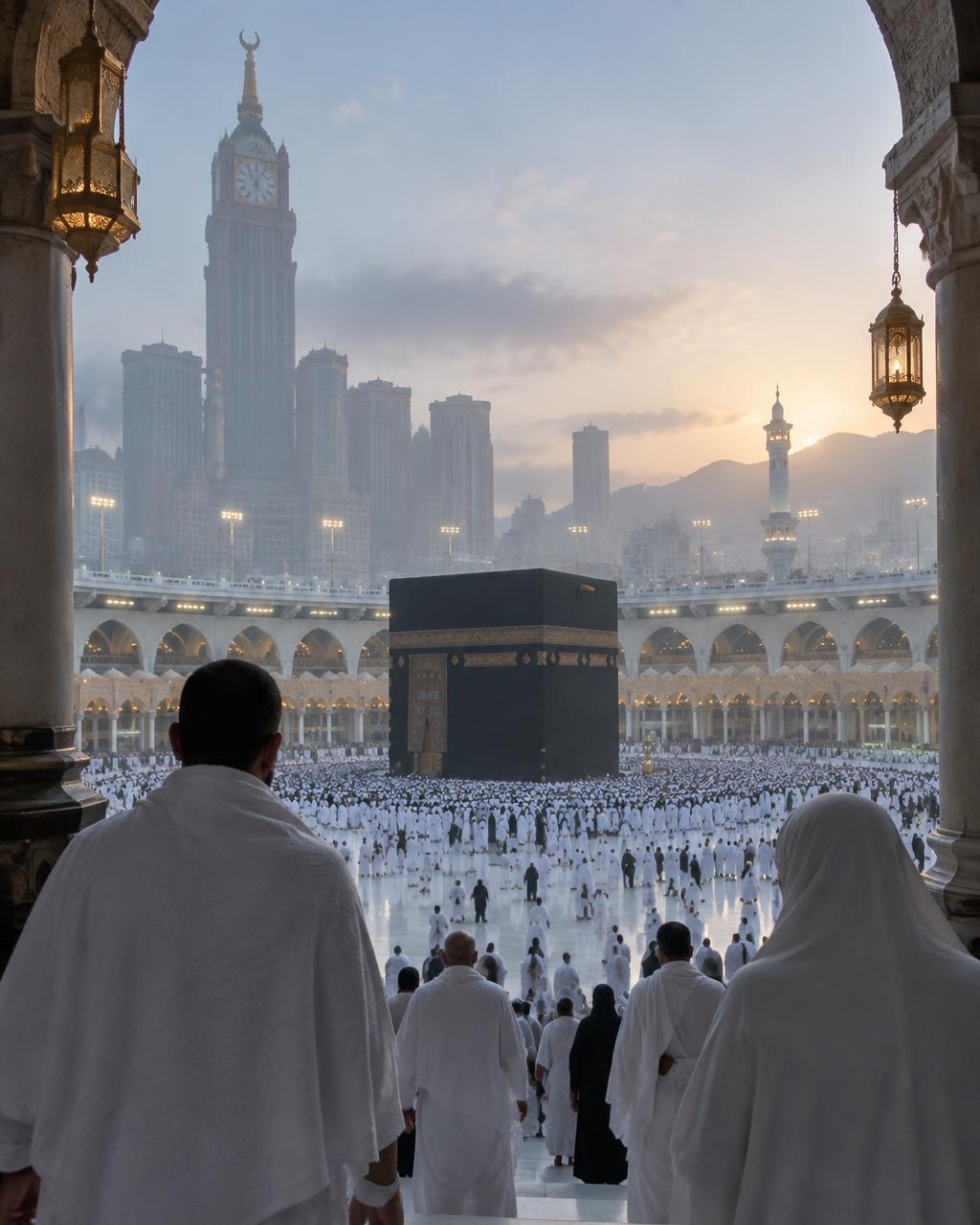
- Umrah has four parts: ihram, tawaf around the Kaaba, sa'i between Safa and Marwa, and cutting the hair.
- It can be performed at any time of year except the days of Hajj, and takes a few hours once you are in Makkah.
- New Muslims may be asked for proof of Islam for the visa; getting a Shahada certificate from a recognised mosque beforehand is wise.
- You can make du'a in your own language during tawaf and sa'i.
- Practice differs in some details between schools, so ask your teacher or a scholar you trust.
In this Guide
If you have recently embraced Islam, or you were born Muslim but have never learned much about Umrah, this guide is for you. It assumes you know nothing, explains every word, and walks through the journey from booking to coming home.
Umrah can feel overwhelming at first: new words, new rules, huge crowds. But the rites themselves are simple, and millions of people perform them for the first time every year. You do not need to be a scholar. You need to understand the basics, prepare well and go with people who can help.
Practice differs in some details between schools of Islamic law. Where it matters, we say so. Your teacher, the imam at your mosque or a scholar you trust can tell you what they follow.
What Umrah is (and is not)
Umrah is a pilgrimage to Makkah, in Saudi Arabia, made up of a few acts of worship performed at and around the Masjid al-Haram, the great mosque that surrounds the Kaaba. It is sometimes called the "lesser pilgrimage".
- Umrah can be performed at any time of year, except that the days of Hajj are reserved for Hajj pilgrims.
- It takes a few hours to perform once you are in Makkah.
- It is not Hajj. Hajj is the major pilgrimage, performed only on specific days each year, with more rites over several days. Umrah is shorter and simpler.
Most pilgrims also visit Madinah, the city of the Prophet Muhammad ﷺ, where they pray in his mosque, the Masjid an-Nabawi. Visiting Madinah is not part of Umrah itself, but it is one of the most loved parts of the journey.
Before you book
- Umrah visas are for Muslims. If you are a new Muslim, or your name is not obviously Muslim, you may be asked for proof that you are Muslim. It is not always asked, but it is wise to get a certificate confirming your Shahada from a recognised mosque or Islamic centre before you apply.
- Learn the basics first. If you are new to prayer, practise wudu (ablution) and the daily prayers until you are comfortable. You will pray many times a day during the trip.
- Consider going with a group or a mentor. For a first Umrah, having someone to explain each step and answer questions makes a real difference.
- Check your passport. It should be valid for at least six months beyond your travel dates.
- Vaccination. Every Umrah pilgrim needs a meningococcal vaccination at least 10 days before arrival. Pilgrims over 65 or with certain chronic conditions also need proof of COVID-19 vaccination or immunity.
- Your Umrah permit. As well as the visa, Umrah itself is booked as a time slot in Saudi Arabia's Nusuk app. Your provider can help.
The rites, step by step, in plain words
Umrah has four main parts. Here they are in order, as described in the Ministry of Hajj and Umrah's Umrah guide.
1. Ihram: entering the sacred state
Before you reach Makkah, you enter a state called ihram. It has two sides:
- The intention (niyyah). You make the intention in your heart to perform Umrah. Many people also say it aloud: "Labbayk Allahumma 'Umrah" (Here I am, O Allah, for Umrah).
- The clothing. Men wear the two ihram cloths, the izar around the waist and the rida over the shoulders. Women may wear any modest clothing that is loose, covers appropriately and is not designed for adornment. Wearing sandals is allowed.
Ihram must be entered at or before a boundary called the miqat. If you fly straight to Jeddah, you will cross the miqat in the air, so most pilgrims put on ihram before or during the flight and the crew announces when the miqat is near. If you go to Madinah first, you enter ihram later, on the way from Madinah to Makkah.
While in ihram, the Ministry's Ihram guide lists these as prohibited: sexual intercourse, entering into a marriage contract, hunting, shaving the head or cutting nails, and wearing perfume. For women, wearing the niqab or gloves; for men, covering the head or wearing tailored, sewn garments. The guide notes that bathing, bandaging wounds, wearing sandals, and a woman covering her face in the presence of non-mahram men are not prohibited. Your teacher can explain what to do if you make a mistake.
After entering ihram, pilgrims recite the talbiyah, a short declaration that begins "Labbayka Allahumma labbayk" (Here I am, O Allah, here I am). The Ministry's guide gives the full words.
2. Tawaf: walking around the Kaaba
At the Masjid al-Haram, you walk around the Kaaba seven times, keeping it on your left, starting at the Black Stone and ending at it. A green light marks the line of the Black Stone. The Ministry's guide says kissing the Black Stone is a sunnah for those able to do it; otherwise you gesture towards it with your hand as you pass.
You can make du'a (personal prayers) in any language during tawaf, recite Qur'an or remember Allah. After the seventh circuit, the guide describes praying two rak'ahs behind the Station of Ibrahim (Maqam Ibrahim), in line with it, or anywhere in the mosque to avoid crowding; on the upper floors, anywhere in the Mataf facing the Kaaba. It then describes drinking Zamzam water as a sunnah.
3. Sa'i: walking between Safa and Marwa
Next, go to the Mas'a, the long gallery inside the mosque between two small hills, Safa and Marwa. Starting at Safa, walk to Marwa: that is one lap. Walking back to Safa is the second. Seven laps in total, finishing at Marwa. Between two green lights on the ceiling, the guide describes walking briskly (harwalah) before returning to a normal pace. Ask your teacher how this applies to you.
Sa'i commemorates Hajar, the mother of the Prophet Isma'il, who ran between these hills searching for water for her son. As with tawaf, you can make du'a in your own words.
4. Halq or taqsir: cutting the hair
To finish, men either shave their head (halq) or trim their hair (taqsir). Women trim the length of a fingertip. There are barbers near the Haram for men.
Your Umrah is now complete. In the guide's words, you exit ihram and what was forbidden because of ihram is permitted again.
A note for women: when 'Aisha had her period during Hajj, the Prophet ﷺ told her to do what all pilgrims do, "except that you do not perform the Tawaf round the Ka'ba till you are clean" (Sahih al-Bukhari 305). Ask a scholar or a knowledgeable woman teacher before you travel how to plan for this.
Words you will hear — a glossary
- Allahu akbar: "Allah is the greatest."
- Du'a: a personal prayer or supplication, in any language.
- Haram: the sacred mosque in Makkah (Masjid al-Haram), or in Madinah (Masjid an-Nabawi). Different from haram meaning "forbidden".
- Ihram: the sacred state, and the clothing, of a pilgrim.
- Kaaba: the cube-shaped building at the centre of the Masjid al-Haram, which Muslims face in prayer.
- Labbayk: "Here I am", the start of the talbiyah.
- Maqam Ibrahim: the station of Ibrahim, a small structure near the Kaaba.
- Miqat: the boundary where pilgrims must be in ihram.
- Niyyah: intention.
- Nusuk: Saudi Arabia's official app for Umrah permits and visits.
- Rak'ah: one unit of prayer.
- Rawdah: an area in the Prophet's Mosque in Madinah; visits are booked in the Nusuk app.
- Sa'i: walking seven times between Safa and Marwa.
- Tawaf: walking seven times around the Kaaba.
- Talbiyah: the pilgrim's declaration, "Labbayk Allahumma labbayk…"
- Wudu: the ritual washing before prayer.
- Zamzam: the blessed water from the well in the Haram.
What to pack
- Ihram: for men, two sets of ihram cloths and a belt; for women, comfortable modest clothing.
- Comfortable footwear you have already walked in, plus sandals for ihram.
- Unscented toiletries, because perfume is not allowed in ihram.
- A small bag for shoes in the mosque, a prayer mat and a water bottle.
- Your medicines in original packaging, with a doctor's letter if needed.
- Copies of your passport, visa and vaccination certificate, and your certificate of Islam if you have one.
Our packing checklist and Saudi medication rules has the full list.
Your first day in Makkah
- Rest first if you need to. If you arrive tired, it is fine to sleep before performing Umrah, as long as you remain in ihram and avoid what is restricted.
- Choose a calmer time. Late at night or mid-morning is often less crowded than just after the main prayers.
- Agree a meeting point with your group at a numbered gate, in case you get separated.
- Go slowly. Take your time. You do not need to rush any part of Umrah.
- Feel what you feel. Many people cry the first time they see the Kaaba. Others feel calm. Both are normal.
In Madinah
In Madinah, pilgrims pray in the Masjid an-Nabawi, the Prophet's Mosque, and many send greetings of peace to the Prophet ﷺ at his resting place. A visit to the Rawdah, an area within the mosque, is booked as a time slot in the Nusuk app, with separate times for men and women. Your group or provider can help you book.
Many pilgrims also visit Quba Mosque, the first mosque built in Islam, and other places of history in and around the city.
Coming home
Coming home can feel strange after days spent in worship. Many pilgrims find it helps to:
- Keep one new habit, such as a prayer you rarely missed in Makkah, or a daily du'a.
- Stay in touch with the people you travelled with.
- Talk to your teacher or mentor about what you experienced and what you want to learn next.
If you would like your first Umrah guided by a mentor, with an orientation session before you travel and follow-up after you return, see our First Umrah service. Our step-by-step DIY Umrah guide covers the practical planning in more detail.
Indicative hotels, private transport and ziyarat: ₹1,23,356 – ₹1,66,894This is a planning estimate, not a firm quote. Excludes flights and visa. Open the full calculator or build your trip.
Good to know
Frequently asked questions
01Can a new Muslim perform Umrah?
02What are the steps of Umrah?
03Do I need to learn Arabic prayers for Umrah?
04What do women wear for Umrah?
05How long does Umrah take?
06Is Umrah the same as Hajj?
Marhaba Haji Pilgrimage Editorial
Verified GuidanceSenior Pilgrimage Logistics & Guidance Specialist
Authored by Marhaba Haji's pilgrimage specialists with hands-on experience guiding pilgrims across Makkah and Madinah.
How Marhaba can help
First Umrah
Small, mentor-led departures for reverts and first-time pilgrims — learn first, then travel.
About First Umrah